
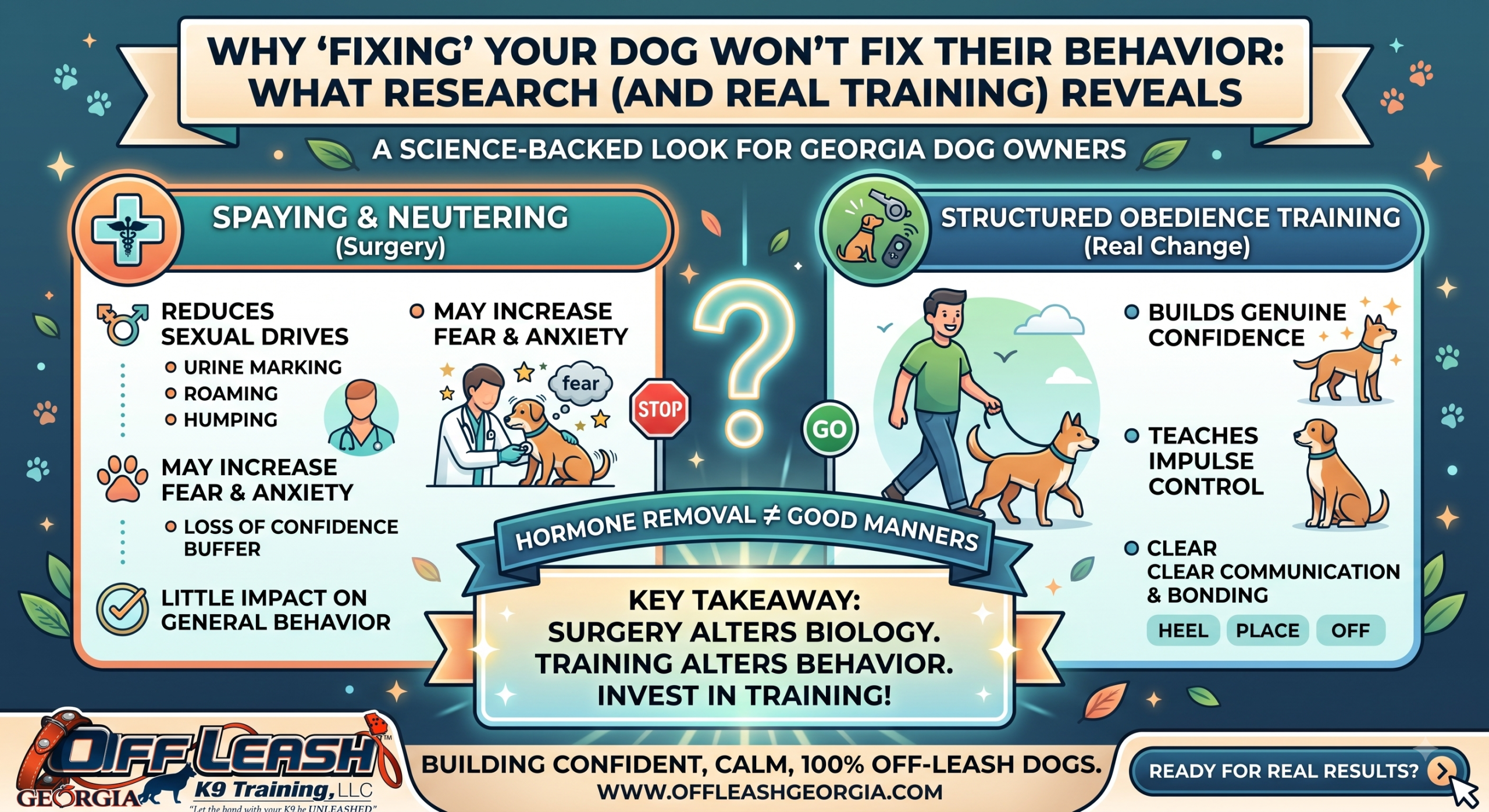
Why “Fixing” Your Dog Won’t Fix Their Behavior: What Research (and Real Training) Reveals
For decades, dog owners across Georgia have been given the same standard advice when their dog starts lunging on the leash, barking at visitors, or acting hyperactive:
“Just get them fixed! That’ll calm them right down.”
It sounds like an easy fix—a quick surgical procedure to wave a magic wand over behavioral issues. But ask any experienced dog trainer, and they’ll tell you the same thing: you cannot scalpel your way out of a training problem.
Now, a growing stack of massive scientific studies confirms what balanced trainers have seen in the field for years. Fixing a dog does very little to solve general behavior problems—and in many cases, it can actually make fear, anxiety, and reactivity worse.
Here is a look at what the research reveals, why this happens, and how we reframe this at Off Leash K9 Training, Georgia.
What the Science Actually Says
When researchers began analyzing large-scale datasets on canine behavior, the results shocked many in the traditional veterinary community.
Two of the largest landmark investigations—conducted by Duffy & Serpell (University of Pennsylvania) and Dr.Parvene Farhoody & Dr. Christine Zink (Hunter College)—examined C-BARQ (Canine Behavioral Assessment and Research Questionnaire) data from over 15,000 dogs.
Instead of finding that spaying and neutering turned dogs into calm, perfectly behaved angels, the data showed the exact opposite:
-
Increased Aggression & Reactivity: Neutered and spayed dogs frequently showed higher levels of fear-based aggression toward strangers and other dogs compared to intact dogs.
-
Spikes in Fear & Anxiety: Desexed dogs showed a roughly 31% increase in fearfulness and a 33% increase in touch sensitivity. They were also significantly more prone to noise phobias (like storm or fireworks panic).
-
Higher Excitability: Rather than “calming down,” fixed dogs often demonstrated higher excitability and lower frustration tolerance.
-
Lower Trainability: In several C-BARQ categories, intact dogs were scored as more responsive to training cues than their neutered counterparts.
What Does Neutering Actually Change?
The research is clear that spaying or neutering reliably reduces sexually dimorphic behaviors driven directly by mating hormones:
-
Urine marking in the house
-
Roaming / escaping to find a mate
-
Sexual mounting/humping
Beyond those reproductive drives, surgery does almost nothing to address core behavioral issues like poor manners, reactivity, or lack of impulse control.
Why Does Fixing a Dog Sometimes Worsen Behavior?
To understand why desexing a dog can backfire behaviorally, you have to look at how hormones affect the canine brain.
1. Testosterone is a Confidence Booster
In both humans and dogs, testosterone plays a vital role in regulating stress, social motivation, and confidence. It acts as a natural buffer against fear and anxiety.
When you remove testosterone from a young male dog that is already inherently nervous, skittish, or insecure, you strip away his natural confidence buffer. Without that hormonal buffer, his insecurity turns into fear—and in the dog world, fear frequently manifests as defensive reactivity or aggression (“I’ll scare you away before you can hurt me”).
2. Estrogen and Progesterone Affect Emotional Balance
In females, gonadal hormones interact with brain chemistry, including serotonin levels. Early spaying can alter emotional resilience, leading to increased touch sensitivity, irritability, or fearfulness in certain breeds and individuals.
Reframing the Issue: The Off Leash K9 Training Perspective
At Off Leash K9 Training, Georgia, we don’t judge owners for whether they choose to alter their dogs or keep them intact—that is a health decision made between you and a trusted veterinarian.
However, we do want pet owners to be clear about what surgery can and cannot achieve.
       [ SURGERY ]                      [ OBEDIENCE TRAINING ]
Reduces mating drives:           Builds real-world confidence:
  • Roaming                        • Leash neutrality
  • Marking                        • Impulse control
  • Mounting                       • Clear communication & focus
1. Behavior is Built on Structure, Not Surgery
A dog doesn’t pull on the leash because they have testicles or ovaries; they pull because they haven’t been taught how to yield to pressure or focus on their handler. Removing reproductive organs does not teach a dog what “Place,” “Heel,” or “Off” means.
2. Insecure Dogs Need Confidence, Not Hormonal Deficits
If your dog is lunging at other dogs on a walk, 9 times out of 10 it is rooted in insecurity or frustration, not “macho dominance.” Waiting for a spay or neuter to fix leash reactivity usually leads to disappointment. What an insecure dog actually needs is clear boundaries, predictable communication, and structured exposure that builds genuine confidence.
3. Already Fixed Your Dog? Don’t Panic!
If your dog is already spayed or neutered and struggling with anxiety or reactivity, you haven’t broken them permanently. It simply means they need a clear framework to navigate the world without relying on natural hormones for confidence.
Through state-of-the-art obedience training, clear markers, and consistent engagement, we give desexed dogs the exact structure they need to feel safe, calm, and in control.
The Bottom Line
If you are dealing with behavioral issues like barking, lunging, jumping, or anxiety, do not rely on a surgical procedure to solve the problem.
Hormones are not a substitute for education, and surgery is not a substitute for training. Real, lasting behavioral transformation comes from clear communication, strong engagement, and high-level obedience.
Got a dog struggling with reactivity, fear, or lack of focus in Georgia? Whether intact or fixed, our team at Off Leash K9 Training, Georgia specializes in turning distracted, anxious dogs into confident, 100% off-leash obedient companions.