
Why We Require a Negative Fecal Test Before Board & Train (And What to Do If It’s Positive)
Preparing your dog for a Board & Train program is an exciting milestone. You are packing their favorite food, double-checking their gear, and getting ready for a lifestyle transformation. But when you look over our intake requirements at Off Leash K9 Training Georgia, one item often prompts questions: a mandatory negative fecal test within 30 days of drop-off.
Clients occasionally ask if this step is truly necessary, especially if their dog is acting energetic, eating well, and producing solid stools.
The short answer is yes. Strict fecal screening is not administrative red tape—it is our first line of defense in keeping every dog in our care safe, healthy, and ready to learn.
Why Fecal Screening Is Non-Negotiable
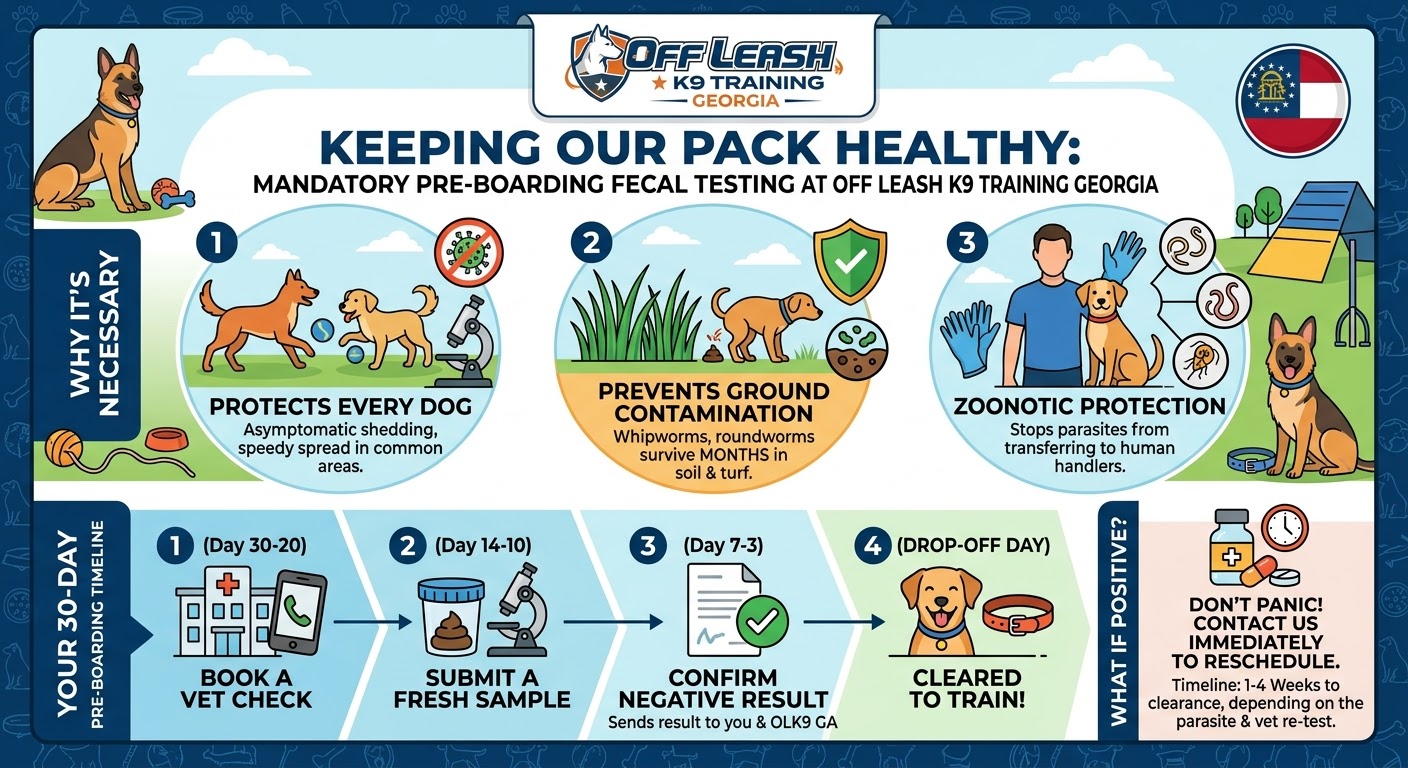
Communal canine environments—whether high-end training facilities, boarding kennels, or daycare centers—carry inherent biological risks. Intestinal parasites spread quickly, quietly, and persistently.
1. Most Carriers Show Zero Symptoms
A dog does not need to have diarrhea, vomiting, or weight loss to carry an intestinal parasite. Dogs frequently carry organisms like Giardia, coccidia, hookworms, and roundworms while appearing completely healthy. During this asymptomatic phase, they actively shed microscopic eggs and cysts in their stool, exposing every dog around them.
2. Protecting Shared Training Grounds and Turf
Our training yards, outdoor relief zones, and turf areas are shared spaces where dogs exercise, train, and socialize. Certain parasite eggs (particularly whipworms and roundworms) have thick protective shells that allow them to survive in outdoor soil and grass for months or even years. Once outdoor grounds are contaminated, eradicating the eggs without completely stripping the soil is nearly impossible. Screening every dog before arrival keeps our training environment pristine.
3. Stress Lowers Natural Defenses
Even positive stress—like moving to a new environment, meeting new trainers, and engaging in focused mental work—can temporarily alter a dog’s gut microbiome and suppress immune response. An asymptomatic, low-level parasite load can flare into acute gastrointestinal distress under training stress, sidelining your dog’s education.
4. Handler and Staff Safety
Several common canine parasites are zoonotic, meaning they can transmit from dogs to humans. Our trainers and kennel staff handle dogs, clean living suites, and pick up waste daily. Strict health policies safeguard our human team just as much as our pack.
When and How to Get the Test Done
To ensure results are current, we require the screening to be completed within 30 days of your scheduled drop-off date.
* No Exam Needed: Most veterinary clinics do not require an office visit for a fecal check. You can simply pick up a collection container (or use a clean plastic bag), collect a fresh sample from your yard, and drop it off at your vet’s front desk.
* The Right Panel: When submitting the sample, ask your veterinarian for a comprehensive fecal screening that includes both a flotation and a Giardia antigen/ELISA test.
* Buffer Time: Reference labs typically turn results around in 24 to 72 hours. We strongly recommend submitting your sample 10 to 14 days before your start date so you have plenty of time to receive results or treat an unexpected finding.
What Happens If the Test Comes Back Positive?
First: do not panic. Parasites are incredibly common. Dogs pick them up from sniffing grass, stepping in contaminated puddles, drinking standing water, or playing at dog parks. A positive result is not a reflection of your care as an owner.
If your dog tests positive, they cannot enter the facility until the infection is cleared. Here is what the treatment and retest timeline typically looks like:
| Parasite | Common Treatment | Medication Window | Retest Timing | Total Clearance Window |
|—|—|—|—|—|
| Roundworms / Hookworms | Dewormer (Fenbendazole or Pyrantel) | 1–3 days, repeated in 14–21 days | 2–3 weeks after dose 2 | 3 to 4 weeks |
| Whipworms | Fenbendazole (Panacur) | 3 consecutive days, repeated in 3 weeks | 2–3 weeks post-dose | 3 to 4 weeks |
| Coccidia | Antibiotic (Albon) | 5 to 14 consecutive days | 1–2 weeks post-treatment | 2 to 3 weeks |
| Giardia | Metronidazole and/or Panacur | 5 to 7 days | See note below | 1 to 4 weeks |
The “Giardia Antigen” Nuance
Giardia can be tricky when it comes to retesting. Even after the medication completely kills the living parasite, harmless remnants of dead Giardia protein (antigens) can shed in your dog’s stool for 2 to 4 weeks.
If your vet runs an ELISA antigen test immediately after treatment, it will often register as a “false positive” even though the infection is cured. To avoid unnecessary delays:
* Bathe your dog thoroughly on the final day of medication to wash away any cysts clinging to their fur.
* Ask your vet to perform a centrifugation fecal flotation (a microscopic examination looking for live, active cysts) rather than an antigen test for your follow-up check.
* If the flotation is negative and your dog has zero clinical symptoms, your vet can provide a signed clearance note stating the active infection has resolved.
We Work With You
If your dog tests positive right before their scheduled Board & Train, reach out to our team immediately.
We will simply push your start date back by a few weeks to give the medication time to work and allow your vet to confirm clearance. You will not lose your training deposit or forfeit your spot.
Our priority is returning a dog to you that is not only exceptionally well-trained, but vibrant, healthy, and thriving. Requiring a clean bill of digestive health ensures every dog that walks through our doors receives the safe, high-standard experience they deserve.