How to Stop Dog Barking at the Door: Why E-Collars Beat Ultrasonic Devices
How to Stop Dog Barking at the Door: Why E-Collars Beat Ultrasonic Devices
If you are frantically searching “how to stop dog barking at the door?” every time the doorbell rings, you are not alone. Door reactivity is one of the most common behavioral issues we see at Off Leash Georgia. When a delivery driver approaches or a guest knocks, your dog’s natural instinct is to alert you. But when that alert turns into a chaotic, uncontrollable barking fit, it becomes a major source of stress.
Many dog owners desperate for a quiet home turn to electronic “quick fixes,” like ultrasonic bark deterrents (devices that emit a high-pitched beep only dogs can hear). While these seem like an easy, hands-off solution, they often fail to create lasting behavioral change.
Here is why our trainers at Off Leash Georgia rely on remote e-collar training over ultrasonic devices to fix door manners quickly, fairly, and permanently.
⚠️ Crucial Warning: The Conditioning Phase is Mandatory
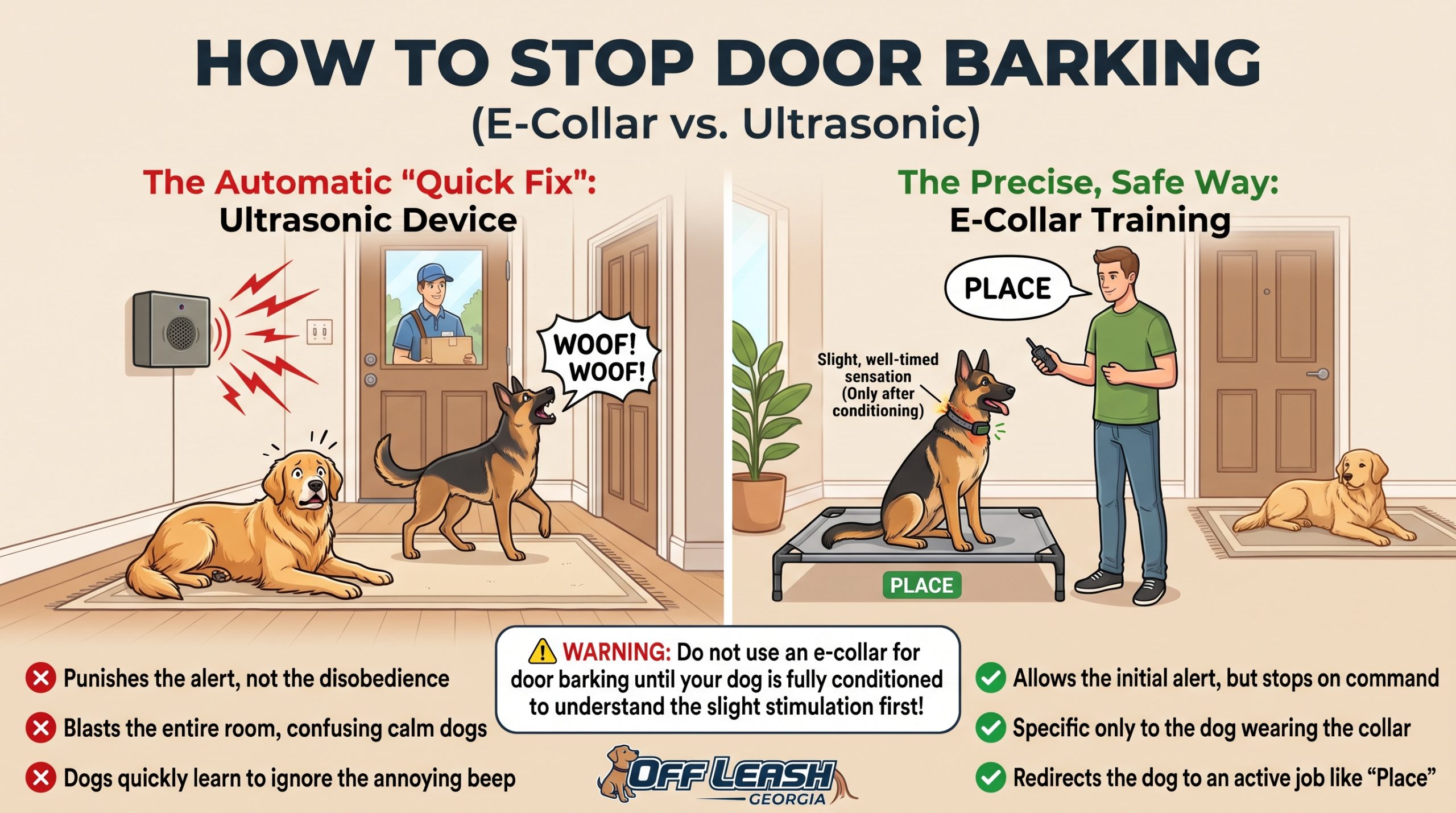
Before comparing the tools, we must address the most important rule of e-collar training: An e-collar should never be used to correct door barking until the dog has been adequately taught what the slight stimulation means.
If you apply stimulation during a highly arousing event (like a stranger at the door) without foundational training, the dog will simply panic because they do not understand how to turn the pressure off. At Off Leash Georgia, we spend dedicated time in low-distraction environments teaching the dog that a low-level tap means “pay attention to the handler” or “go to your bed.” Only after the dog fully understands this language can the e-collar be used to enforce commands at the front door.
The Problem with Ultrasonic Bark Deterrents
Ultrasonic devices are automated. The moment a dog barks, the device emits a high-pitched noise. This presents several major training roadblocks:
-
It punishes the instinct, not the disobedience: You likely want your dog to let you know someone is at the door—you just want them to stop when you say “Quiet.” An ultrasonic device punishes the very first bark, confusing a dog that thinks they are doing their job.
-
Area-of-effect confusion: Sound bounces off walls. The dog often cannot pinpoint where the correction is coming from or why it is happening, leading to anxiety rather than learning.
-
Rapid habituation: Dogs are incredibly adaptable. When their protective drive is triggered by a stranger at the door, that high-arousal state easily overpowers the annoyance of a beep. They quickly learn to ignore it and bark right through the noise.
The E-Collar Advantage for Door Manners
When properly conditioned, the e-collar is not about fear; it is about tactile clarity. Here is why an e-collar is the superior tool for stopping door barking:
1. Precision Timing for Commands An e-collar puts you in control, not an automated microphone. You can allow your dog to give one or two alert barks, acknowledge the alert, and issue a “Quiet” or “Enough” command. If the dog ignores your command, you instantly apply a tactile sensation to interrupt them. This teaches the dog that the alert is acceptable, but ignoring your command is not.
2. Perfect for Multi-Dog Households If you have more than one dog, ultrasonic devices are disastrous. If your reactive dog barks at the door, the ultrasonic noise blasts every dog in the room, punishing your calm, quiet dog for doing absolutely nothing wrong. An e-collar is paired specifically to the dog wearing it. You can correct the barking dog without unfairly stressing out the rest of your pack.
3. Beating the High-Drive State Unlike a beep that a dog can easily tune out, an e-collar’s stimulation levels are highly adjustable. A trainer can match the dog’s level of arousal. A light tap is often enough to break the dog’s intense fixation on the front door, bringing their attention back to you so you can guide them.
4. Redirecting to the “Place” Command Stopping the barking is only half the solution; you must tell the dog what to do instead. The fastest way to fix door reactivity is teaching an incompatible behavior, such as the “Place” command (going to a specific bed or cot and staying there). Ultrasonic devices cannot teach a dog where to go. E-collars excel at reinforcing directional commands. You can apply continuous, low-level pressure that turns off the exact second your dog steps onto their Place cot, clearly teaching them how to succeed.
Take Control of Your Front Door
You do not have to live with the chaos of a ringing doorbell. By replacing ineffective, confusing sound devices with clear, command-driven e-collar training, you can teach your dog to be a polite, well-mannered member of the family.
Ready to transform your dog’s behavior safely and effectively? Reach out to the expert team at Off Leash Georgia to start your training journey today.