Why On-Leash Dog Greetings Cause Leash Reactivity: What Science (and Real Training) Reveals
It’s one of the most common sights in neighborhoods across Georgia: two owners walking their dogs on leash, spotting each other, and saying with a smile:
“It’s okay! He’s friendly! They can say hi!”
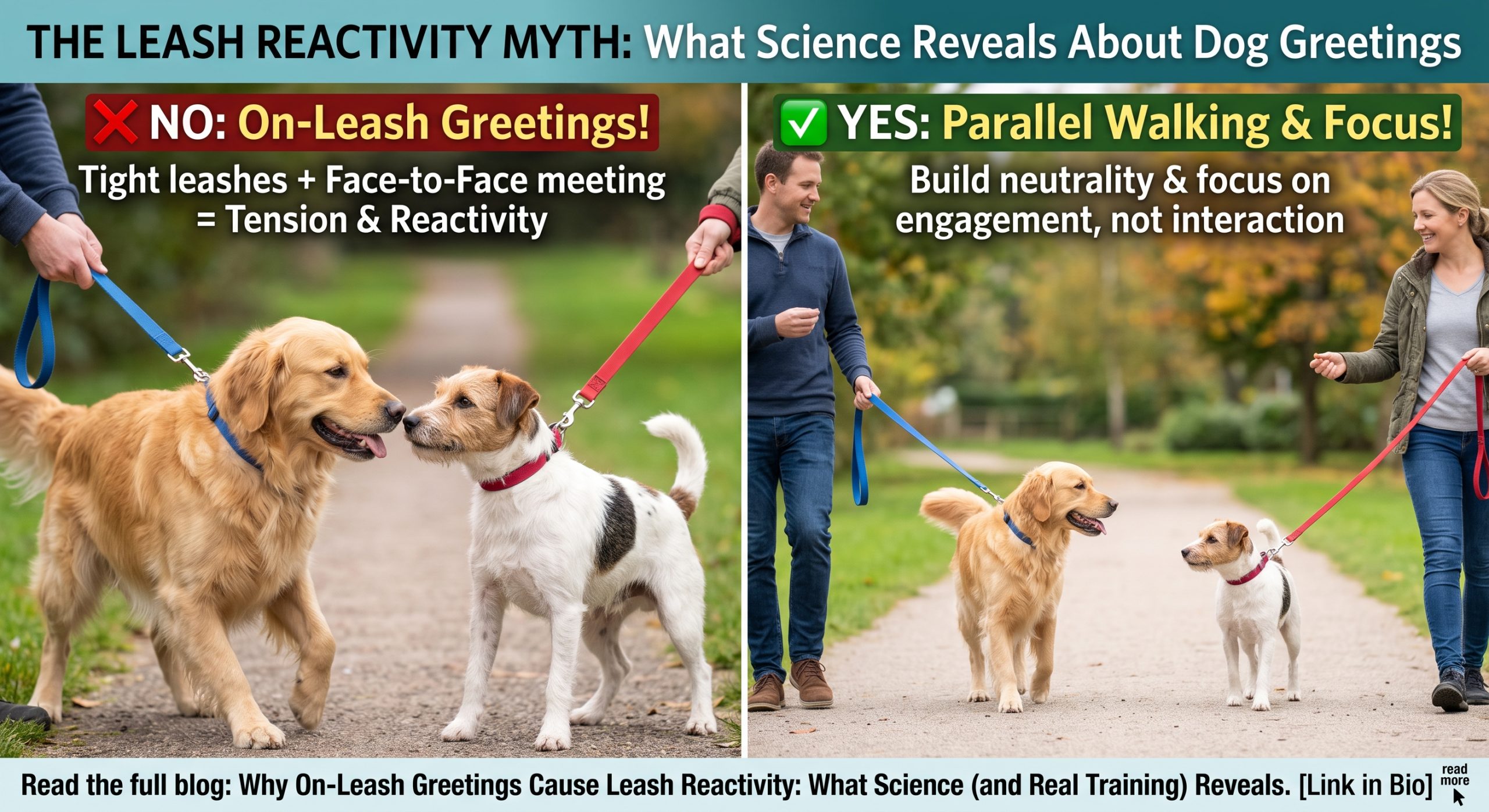
They shorten their hold, let the dogs pull toward each other face-to-face, and watch as the dogs sniff frantically for three seconds—until one suddenly growls, lunges, or snaps.
Fast-forward a few months, and that same “friendly” dog is now barking hysterically and lunging at every single dog they see across the street.
At Off Leash K9 Training, Georgia, leash reactivity is one of the top behavioral issues clients ask us to solve. Owners are often bewildered: “He loves other dogs at daycare! Why does he turn into a monster when he’s on a walk?”
The answer comes down to behavioral science. On-leash greetings are one of the fastest ways to create frustration-based leash reactivity.
Here is what behavioral research reveals about why on-leash greetings backfire, why “socialization” doesn’t mean what most people think, and how real training fixes the problem for good.
1. The Science of “Barrier Frustration”
To understand why a friendly dog turns into a lunging mess on a leash, you have to look at the psychology of Barrier Frustration.
In animal behavioral science, a barrier is anything that prevents an animal from reaching something they desire. It can be a fence, a window, or a six-foot nylon leash.
[ INTENSE DESIRE TO GREET ] + [ PHYSICAL LEASH RESTRAINT ] = [ BARRIER FRUSTRATION & LUNGING ]
The Frustration-Aggression Loop
-
The Expectation: When you allow your dog to greet other dogs on leash, you condition them to expect that everydog they see is a playmate.
-
The Barrier: When a dog sees another dog across the street and isn’t allowed to reach them, the leash acts as a physical barrier.
-
The Emotional Explosion: Because the dog has been conditioned to expect access, being held back triggers intense excitement that rapidly turns into emotional frustration.
When excitement cannot be fulfilled, adrenaline spikes. That internal pressure releases through outward vocalization and lunging. To an outside observer—or the other dog—it looks like pure aggression, but it started entirely as thwarted excitement.
2. Pavlovian Conditioning: How “Friendly” Becomes “Reactive”
Classical conditioning (Pavlovian response) is constantly occurring on your daily walk, whether you realize it or not:
-
Trigger: Your dog sees another dog.
-
Action: You tighten the leash and allow a tense, face-to-face greeting.
-
Internal State: Adrenaline spikes, muscle tension increases, and frustration mounts.
Over time, the dog’s brain creates a direct neural association: “Seeing another dog on a leash equals physical restriction, high pressure, and emotional distress.”
Eventually, your dog skips the desire to greet entirely. The mere sight of a distant dog immediately triggers a defense or frustration response: barking, lunging, and pulling before they even get close.
3. Leashes Destroy Natural Canine Body Language
In the dog world, a direct, head-on approach while making unbroken eye contact is considered confrontational and rude.
Under natural, off-leash conditions, dogs never approach each other in a straight line. They curve their body, soften their gaze, lower their head, and approach from the side to sniff rear ends.
NATURAL OFF-LEASH GREETING:         ON-LEASH GREETING:
    Curved approach                     Forced head-on alignment
    Relaxed body curves                 Tense, upright posture
    Side/rear sniffing                  Eye-to-eye pressure & restriction
When you attach a leash, you force two dogs into a stiff, head-on, eye-to-eye alignment. Because the leash keeps their heads pulled up and forward, neither dog can display polite, appeasing body language. They look stiff, tense, and ready to fight—which frequently causes one or both dogs to react defensively.
4. The “Socialization” Misconception
The root cause of this problem is a widespread misunderstanding of the word socialization.
Many dog owners believe socializing a dog means letting them interact with every human and dog they encounter. In behavioral science, true socialization is actually about environmental neutrality—teaching a dog to remain calm, focused, and indifferent to stimuli in their environment.
| Myth: Interaction Socialization | Fact: Neutrality Socialization |
| Lets the dog greet every dog on walks | Teaches the dog to ignore other dogs entirely |
| Creates high arousal and expectation | Creates calm composure and impulse control |
| Leads to barrier frustration and lunging | Leads to reliable, stress-free off-leash focus |
A well-socialized dog isn’t one that plays with every dog in sight; it is a dog that can walk past a barking dog on a narrow sidewalk without breaking focus from their handler.
How Off Leash K9 Training, Georgia Fixes Leash Reactivity
At Off Leash K9 Training, Georgia, we don’t just treat the symptom (the barking and lunging)—we change your dog’s underlying emotional state and expectation around triggers.
1. We Shift Expectation from “Other Dog” to “Handler”
Through clear, state-of-the-art obedience conditioning, we teach your dog that the presence of another dog is not an invitation to greet, nor is it a threat. It is simply a cue to tune in and lock focus on you.
2. We Build Unshakable Impulse Control
Through commands like an off-leash Heel and Place, your dog learns how to process high-arousal environments while remaining calm and composed. Instead of reacting impulsively, they learn how to regulate their own emotions.
3. Clear Communication Means Stress-Free Walks
When you remove the ambiguity of tight leashes and forced greetings, walks become enjoyable again. You won’t have to scan the neighborhood nervously or duck behind parked cars. Your dog will have the clarity and confidence to walk neutrally past any distraction.
Stop Greeting. Start Training.
If your walks have turned into a stressful game of dodging other dogs, it’s time to stop allowing on-leash greetings and start building true neutrality.
Whether your dog is struggling with frustration-based reactivity or deep insecurity, our expert team at Off Leash K9 Training, Georgia specializes in turning distracted, reactive dogs into calm, 100% off-leash obedient companions.
-
Ready to transform your daily walks?
-
Visit us today at offleashgeorgia.com to schedule your consultation!