The “Guilty Look” Myth: Why Your Dog Isn’t Ashamed (And What Science Says They’re Actually Doing)
Every dog owner in Georgia knows “the look.”
You walk through the front door after a long day at work, and before you even drop your keys, you see it: a torn-up throw pillow on the living room rug or an overturned trash can in the kitchen.
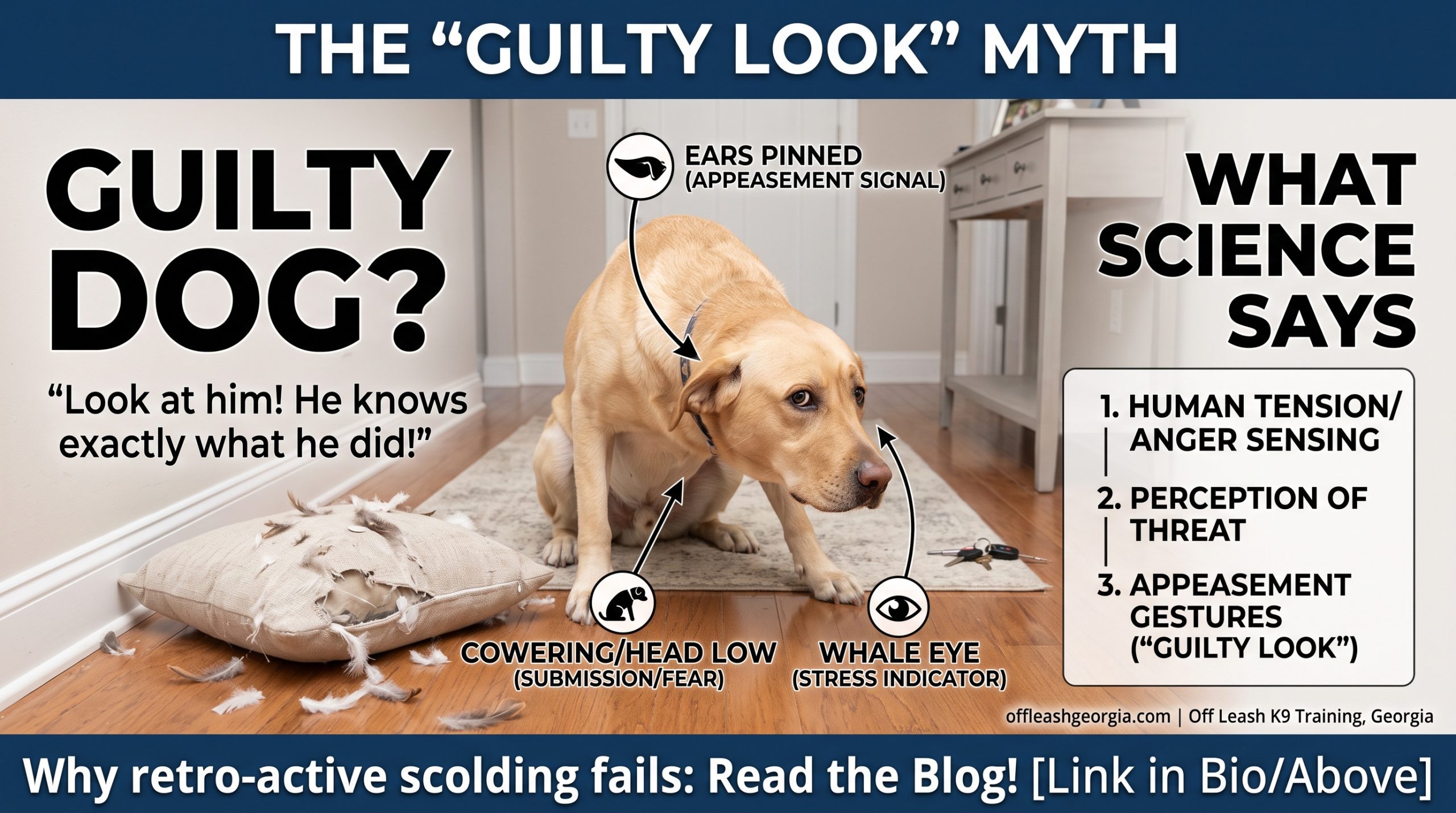
You look at your dog. Their head is low, their ears are pinned flat against their head, their eyes are squinting or showing the whites (“whale eye”), and they’re slinking away toward the hallway.
You sigh and say what millions of owners say every day:
“Look at him! He knows exactly what he did. He feels so guilty!”
It seems like an open-and-shut case. But at Off Leash K9 Training, Georgia, we hear this story constantly—and we have to break the news to loving owners: Your dog does not feel guilty.
That famous “guilty look” is actually one of the most misunderstood behaviors in the canine world. When we misread it, we often destroy trust, increase house anxiety, and fail to solve the actual root problem.
Here is what scientific research reveals about the “guilty look,” why scolding after the fact backfires, and how real training creates clarity instead of fear.
The Landmark Study: Science Proves “Guilt” is an Illusion
The idea that dogs feel shame or guilt for past misdeeds was put to the test in a famous 2009 landmark study conducted by Dr. Alexandra Horowitz, a canine cognition scientist at Barnard College (Columbia University), published in the scientific journal Behavioural Processes.
The Experiment Setup
Dr. Horowitz designed an ingenious test to isolate whether a dog’s body language was caused by their own past action or their owner’s current behavior:
-
Owners placed a high-value treat in front of their dog, commanded them to “Leave it,” and left the room.
-
While the owner was gone, the experimenter either let the dog eat the treat or removed the treat completely.
-
Before the owner returned, the experimenter misinformed the owner: telling them the dog had eaten the treat (when they hadn’t), or telling them the dog was good (when they had actually eaten it).
-
Owners were instructed to either greet their dog warmly or scold them based only on what they were told.
The Shocking Results
If the “guilty look” was driven by a dog’s internal conscience, dogs that ate the forbidden treat would show guilty body language regardless of what their owners thought. But that’s not what happened:
-
Guilt had nothing to do with the act: Whether the dog actually ate the treat made zero difference in whether they displayed “guilty” body language.
-
Scolding triggered the look: Dogs showed the “guilty look” almost exclusively when their owners scolded or reprimanded them.
-
Innocent dogs looked the MOST guilty: The dogs that displayed the highest rate of “guilty” body language were completely innocent dogs that had obeyed the command, but were falsely scolded by misinformed owners!
The Scientific Conclusion: The “guilty look” is not an admission of a past misdeed. It is an immediate, direct reaction to human body language, voice tone, and environmental tension.
If It Isn’t Guilt, What Is It? (Appeasement & Fear)
Humans are hardwired to anthropomorphize—meaning we project human emotions like shame, guilt, and morality onto our pets. But dogs operate on a much simpler, highly effective survival system: Appeasement Gestures.
Dogs are elite observers. They read human body language, micro-expressions, posture, and tone of voice long before we say a word.
When you walk into a room, spot a mess, and tense up—even if your breathing just changes or your brow furrows—your dog instantly registers: “Danger! My human is tense and angry.”
[ HUMAN TENSION / ANGER ] --> [ CANINE PERCEPTION OF THREAT ] --> [ APPEASEMENT GESTURE ("GUILTY LOOK") ]
To de-escalate that perceived threat, the dog displays submissive appeasement signals:
-
Cowering or crouching low to the ground
-
Pinning ears backward against the skull
-
Avoiding direct eye contact (“whale eye”)
-
Licking lips or yawning
-
Slow, tucked tail wags
In dog body language, these gestures mean: “Please don’t hurt me or be mad; I am small and non-threatening.” When humans misinterpret this appeasement as “Aha! He knows he was bad!”, we make a critical training mistake.
The 1.5-Second Rule: Why Scolding After the Fact Fails
The second reason the “guilty look” myth is dangerous comes down to canine neurology and temporal association.
Dogs associate consequences with actions within a window of roughly 1.5 to 2 seconds.
If your dog chews your shoe at 2:00 PM, and you walk in the door at 5:00 PM and yell at them while pointing at the shoe, your dog cannot link the scolding to the act of chewing three hours ago.
Instead, the dog links the scolding to what is happening right now: You walking through the door.
The Breakdown of Trust
| What You Think You’re Teaching | What Your Dog Actually Learns |
| “Don’t chew shoes while I’m at work.” | “When my human comes home and stands near a shoe, they become unpredictable and scary.” |
| “Don’t go into the trash can.” | “Coming near my human when trash is on the floor leads to punishment.” |
| “You need to feel bad for destroying the couch.” | “My home environment is unstable and stressful.” |
When you scold a dog for a past mess, you don’t teach them bad behavior is wrong—you simply teach them that you are unpredictable. This creates chronic anxiety, which ironically leads to more destructive chewing, pacing, and house-soiling while you’re away.
How Off Leash K9 Training, Georgia Solves the Problem
At Off Leash K9 Training, Georgia, we don’t play guessing games with past mistakes, and we don’t rely on fear or retro-active punishment. We build clarity, structure, and proactive communication.
1. Real-Time Timing and Feedback
We teach owners how to mark and correct behaviors in real-time (within that crucial 1.5-second window) or manage the environment so the bad behavior never occurs in the first place.
2. Replacing Destruction with Structure (“Place” Command)
Destructive behavior in the house usually stems from boredom, lack of structure, or separation anxiety. Through commands like “Place,” we teach dogs how to relax on a designated bed for hours at a time, regulating their own nervous system instead of looking for shoes or trash to chew.
3. Building Trust Through Clear Leadership
When your dog understands exactly what is expected of them, anxiety vanishes. You won’t ever need to walk through the door wondering what mess awaits you, and your dog will greet you with genuine, tail-wagging confidence instead of appeasement fear.
Stop Guessing. Start Training.
Your dog doesn’t need to feel guilty—they need to feel clear, confident, and understood.
If you’re tired of coming home to destroyed furniture, chewed shoes, or house messes, stop relying on retro-active scolding. Let our expert trainers show you how structured obedience transforms your dog’s behavior from the inside out.
Whether you’re dealing with destructive house behavior, high anxiety, or lack of focus, our team at Off Leash K9 Training, Georgia specializes in turning high-stress household dynamics into 100% off-leash obedient, peaceful companions.
-
Ready to eliminate destructive habits for good?
-
Visit us today at offleashgeorgia.com to schedule your consultation!