The “Backyard Trap”: Why Free Backyard Access Increases Territorial Anxiety
Ask almost any dog owner in Georgia what their dog’s favorite amenity is, and they’ll point right out the back door:
“We bought this house specifically for the big fenced backyard so our dog could run free and relax!”
It sounds like a dream set-up. You open the back door, let your dog out into the yard, and assume they are getting fresh air, burning off energy, and living their best life.
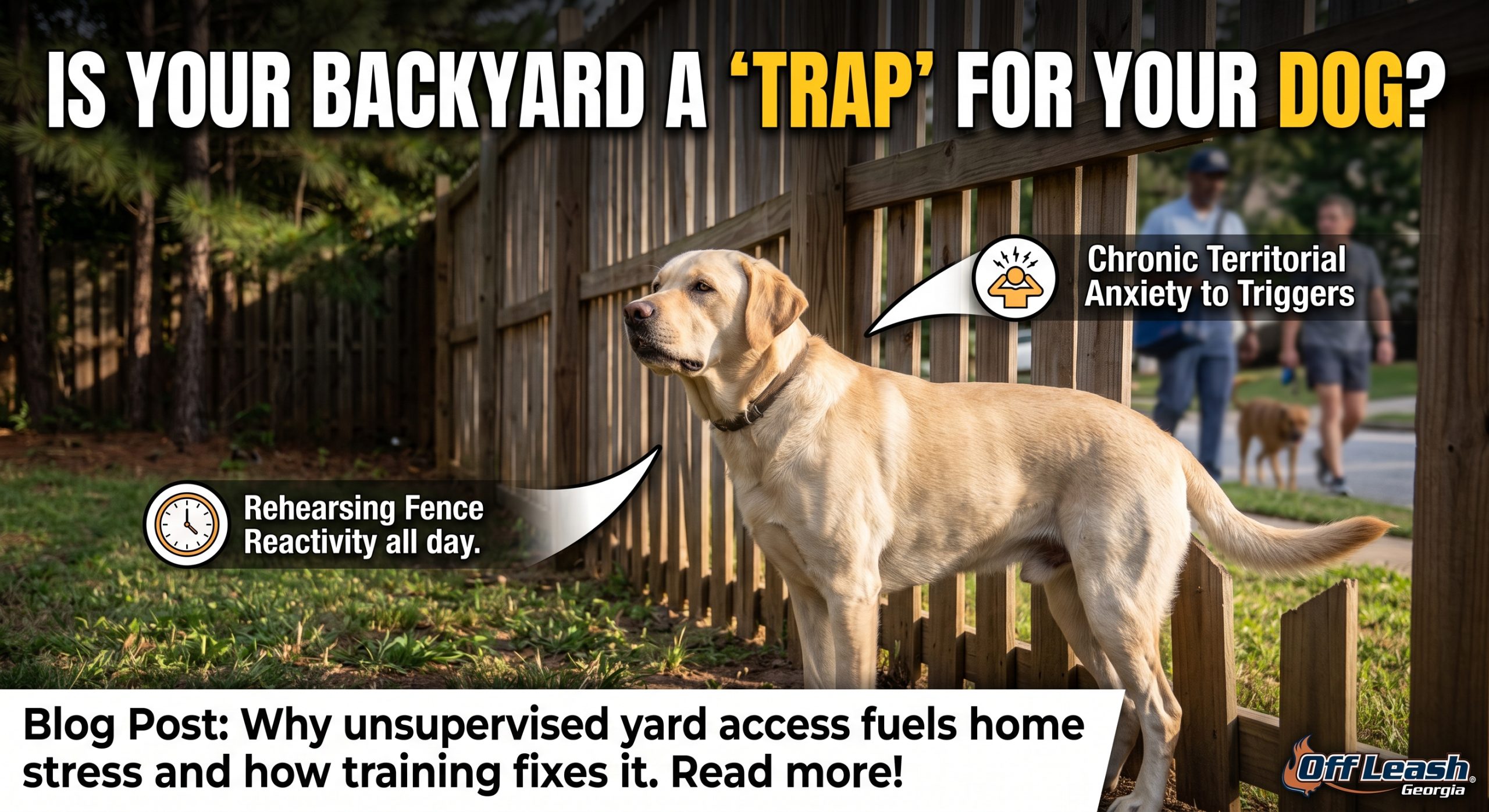
But then the habit forms. Your dog starts pacing the fence line. They sprint along the wooden panels barking frantically at neighbor dogs, lunging at squirrels, or charging the gate every time a delivery driver pulls into the driveway.
When you call them back inside, they don’t seem relaxed—they’re panting, hyper-vigilant, and on high alert at every noise outside the window.
At Off Leash Georgia, we see this pattern constantly. Owners are shocked to learn that unsupervised, free backyard access is one of the leading causes of territorial anxiety, fence reactivity, and chronic home stress.
Here is what behavioral science reveals about “the backyard trap,” why perimeter guard duty ruins your dog’s peace of mind, and how real training fixes the problem for good.
1. The Science of “Barrier Reactivity”
When a dog is left unattended in a fenced yard, their brain processes the environment through the lens of Barrier Reactivity (also known as barrier frustration or barrier aggression).
A fence acts as a physical barrier. In nature, if a dog perceives a threat or distraction, they have the freedom to move away, investigate, or establish distance.
When trapped behind a fence line, they experience high emotional arousal with zero outlet for resolution:
-
Visual Restriction: Seeing a trigger (a walking dog, a runner, or a child on a bike) through fence slats or over a gate triggers a rapid threat-detection response.
-
Thwarted Investigation: The dog wants to investigate or move, but the barrier stops them.
-
Emotional Overload: Frustration rapidly escalates into alarm barking, fence charging, and lunging.
[ UNMONITORED BACKYARD ACCESS ] --> [ BARRIER FRUSTRATION ] --> [ FENCE CHARGING & ALARM BARKING ]
2. “Practice Makes Permanent”: The Neurobiology of Behavior Rehearsal
Every time your dog runs to the fence and barks at a passing mail carrier or neighbor walking their dog, something dangerous happens in their brain: Reinforcement of the Behavior Pathway.
In behavioral psychology, dogs learn through continuous rehearsal. The sequence plays out in your dog’s mind like this:
-
Trigger Appears: A person or dog walks past your backyard fence.
-
Dog Reacts: Your dog charges the fence line, barking hysterically.
-
Trigger Leaves: The passerby continues walking down the street.
-
Brain Conclusion: Your dog believes, “My aggressive barking successfully chased the intruder away and saved the property!”
This creates a powerful self-reinforcing loop. The brain releases a surge of adrenaline, rewarding the dog for “defending the territory.”
When left unattended in the yard for hours every day, your dog rehearses this behavior hundreds of times a month, hardening fence reactivity into an automatic, hardwired reflex.
3. The “Stress Bucket” & Chronic Hyper-Vigilance
Leaving a dog in the yard for hours doesn’t drain their energy—it fills their stress bucket.
When a dog is stationed in a backyard with continuous access to environmental triggers, they are forced into a permanent state of perimeter guard duty. Their brain is constantly scanning for threats.
The Hormonal Toll
-
Adrenaline: Provides immediate energy for fence charging, spiking heart rate and muscle tension.
-
Cortisol: The primary stress hormone released to handle prolonged tension.
While adrenaline fades quickly, cortisol stays elevated in a dog’s bloodstream for up to 24 to 48 hours.
If your dog is reacting at the fence line every day, their stress bucket never empties. They live in a state of chronic hyper-vigilance, which manifests inside your home as window reactivity, door-bell barking, pacing, and inability to settle.
| Free Backyard Access (Unmonitored) | Structured Backyard Access (Supervised) |
| Puts the dog on perimeter guard duty | Positions the yard as a safe zone for play & relaxation |
| Spikes baseline cortisol & anxiety | Keeps stress levels low and manageable |
| Encourages fence-line reactivity | Teaches focus, recall, and impulse control |
| Fills the “stress bucket” | Drains cognitive energy constructively |
How Off Leash Georgia Fixes The Backyard Trap
At Off Leash Georgia, we don’t believe in letting a fence raise your dog. We teach owners how to transform their yard from an anxiety-inducing battleground into a peaceful space for play, focus, and rest.
1. We Remove Guard Duty from Your Dog’s Shoulders
A dog shouldn’t feel responsible for securing the boundaries of your property. Through state-of-the-art obedience training, we teach your dog that you are in control of the environment, lifting the heavy emotional burden of perimeter defense off their shoulders.
2. Reliable Off-Leash Recall (“Come”)
If your dog charges the fence line right now, will they come when called? Most owners end up chasing their dog around the yard in frustration. We build 100% reliable, off-leash recall—meaning the moment your dog notices a distraction near the fence, a single call brings them straight back to your side with enthusiasm.
3. Teaching a Real “Off-Switch”
Instead of letting your dog pace the yard in a hyper-aroused state, we teach structured commands like “Place” and off-leash focus. Your dog learns how to relax outside, ignore passing distractions, and regulate their own nervous system.
Stop Guarding. Start Training.
Your backyard should be a place of relaxation and fun for your dog—not a chronic source of stress, territorial anxiety, and fence-fighting.
If you are tired of yelling at the back door, dealing with window barking, or feeling like your dog can’t turn off their guard duty, it’s time for a change.
At Off Leash Georgia, we specialize in turning reactive, anxious household dynamics into calm, 100% off-leash obedient companions.
-
Ready to fix fence reactivity and bring peace back to your home?
-
Visit us today at offleashgeorgia.com to schedule your consultation!