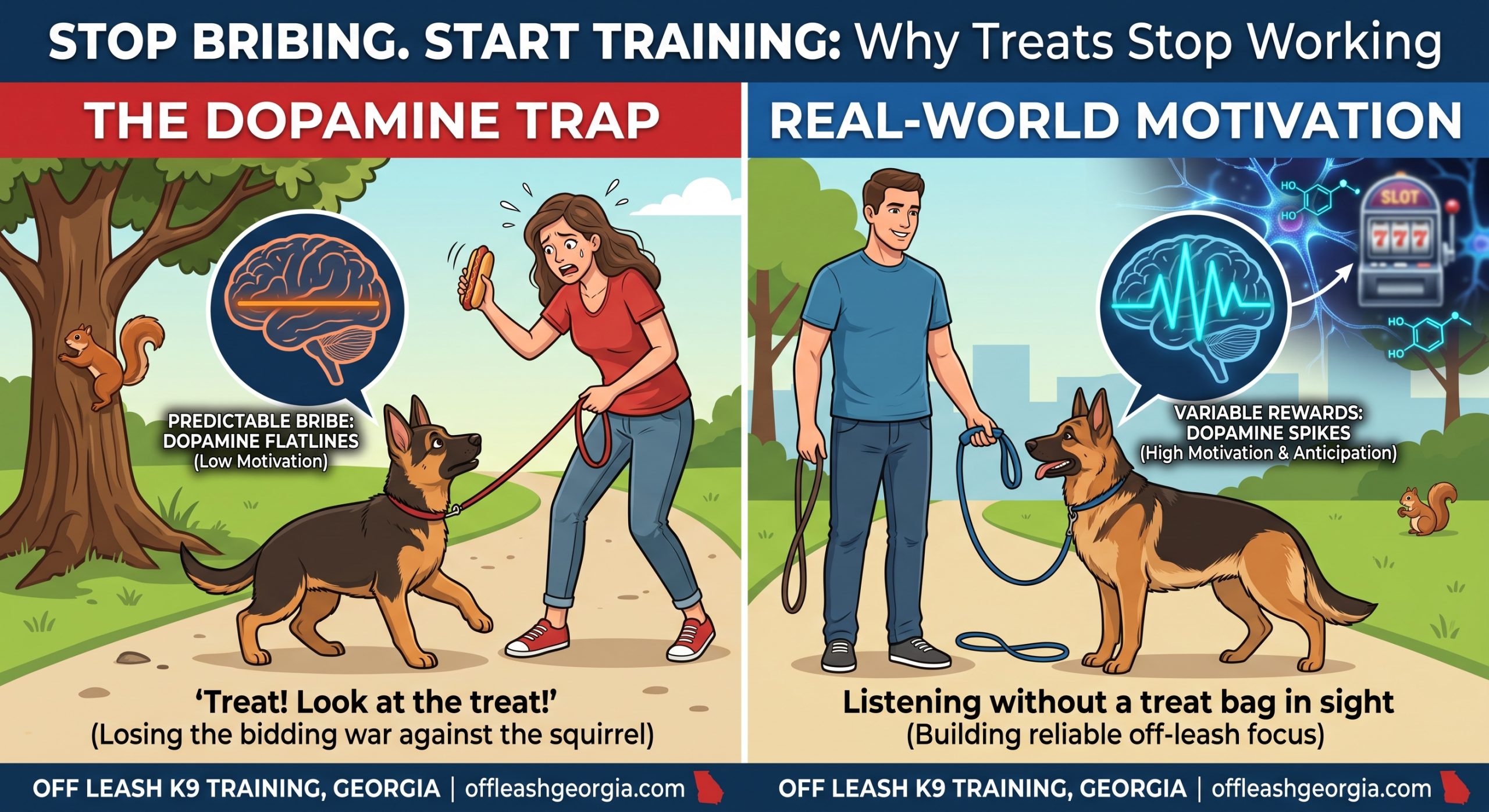
The Dopamine Trap: Why Treats Stop Working (And What Science Says Really Motivates Your Dog)
It’s the classic scenario every dog owner in Georgia has experienced at least once:
You’re standing in your kitchen with a pocket full of hot dog slices or freeze-dried liver. You say “Sit,” and your dog drops their butt instantly. You say “Shake,” and they offer a paw. You feel like a master dog trainer.
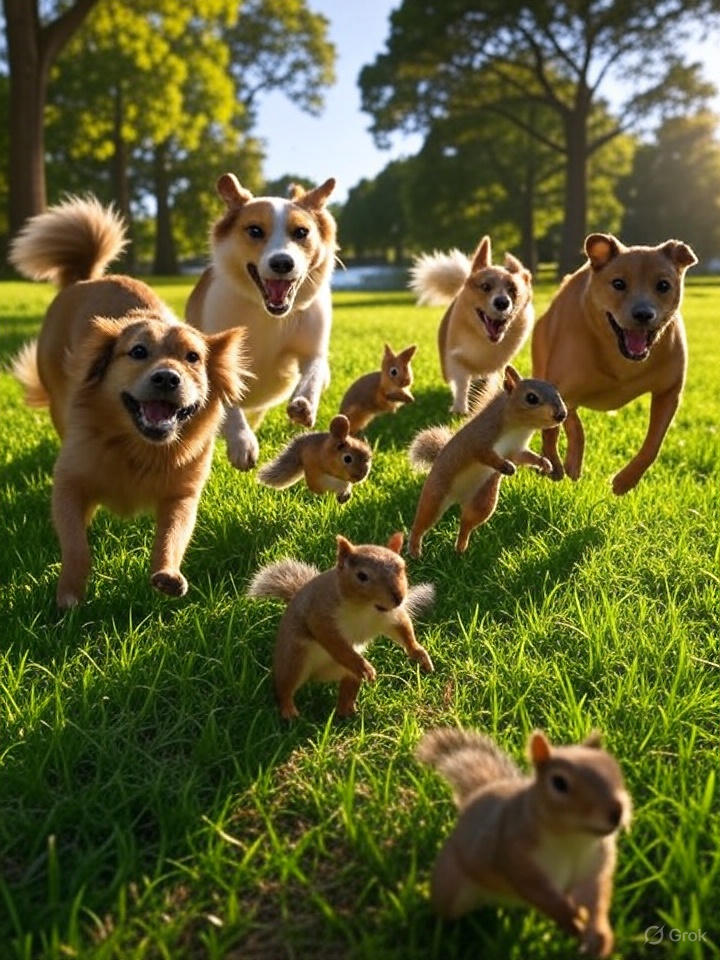
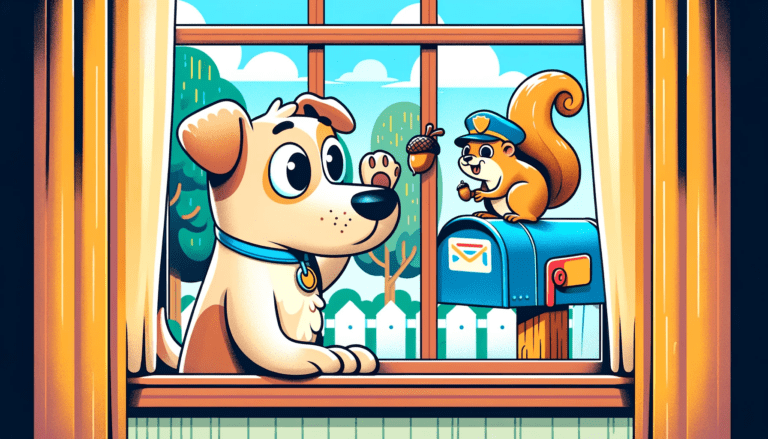
Then you step outside into your front yard. A squirrel darts across the driveway, or a neighbor walks by with their Golden Retriever.
You pull out the hot dog, hold it in front of your dog’s nose, and frantically plead:
“Look! Treat! Sit! Look at the treat!”
Your dog doesn’t even blink. They completely ignore the high-value food, tune you out, and pull toward the distraction like you aren’t even holding the leash.
At Off Leash K9 Training, Georgia, we hear this exact complaint every day: “My dog only listens when I have food in my hand, and even then, treats stop working the second there’s a distraction!”
It isn’t because your dog is stubborn, and it isn’t because you need “higher value” treats. It happens because of a fundamental neurobiological phenomenon known as The Dopamine Trap.
Here is what neuroscience reveals about how your dog’s brain processes rewards, why treat bribery fails in the real world, and how real training creates 100% off-leash reliability without relying on a pocket full of cheese.
1. The Neuroscience of Dopamine: Reward Prediction Error
To understand why treats stop working, you have to understand how dopamine actually functions in the canine brain.
Most people assume dopamine is the “pleasure chemical” released when a dog eats a piece of bacon. But groundbreaking research in behavioral neuroscience—pioneered by neuroscientist Dr. Wolfram Schultz on Reward Prediction Error (RPE)—proved that dopamine is actually the neurochemical of anticipation, motivation, and learning, not consumption.
  [ UNEXPECTED REWARD ]   -->   MASSIVE DOPAMINE SPIKE (High Learning & Motivation)

  [ EXPECTED / BRIBED REWARD ]   -->   DOPAMINE FLATLINES (Low Motivation / Boredom)
How the Brain Calculates Value
Schultz’s experiments demonstrated a clear pattern in how dopamine neurons fire:
-
The Novel Reward: When an animal receives an unexpected reward after performing a behavior, dopamine neurons fire intensely. The brain takes notice and learns: “That was great! Let’s do that again.”
-
The Expected Reward: Once the animal learns that a cue always yields the exact same treat, the dopamine spike shifts from the treat itself to the cue. But if the reward is 100% predictable every single time, the dopamine response flattens.
When you give your dog a treat every single time they sit in a low-distraction environment, the food loses its neurochemical excitement. It becomes predictable background noise.
2. The Competing Value Equation (Environment vs. Food)
When your dog is in the living room, a piece of chicken is the most interesting thing in the room. But the moment you step outside, the environment presents competing stimuli that trigger massive natural dopamine spikes:
-
The scent of a rabbit in the grass
-
The visual movement of a running squirrel
-
The arousal of seeing another dog
Neurobiologically, chasing, sniffing, and scanning the environment release far more dopamine than eating a piece of dry kibble.
When you attempt to use a treat to distract a dog that is already fixated on a squirrel, you are entering a neurochemical bidding war—and losing. In that moment, the environment is worth 100 points of dopamine, while your treat is only worth 10. The dog makes a rational biological choice: they choose the environment.
3. Bribery vs. Reinforcement: The Fundamental Mistake
The reason treats fail in high-distraction environments usually comes down to a critical distinction in psychology: Bribery vs. Reinforcement.
| Feature | Treat Bribery | True Reinforcement |
| Timing | Show the food before the behavior | Reward delivered after the behavior is complete |
| Dog’s Focus | Focused on the food in your hand | Focused on you and the task |
| Function | Lures/bribes the dog to ignore a trigger | Reinforces a decision the dog already made |
| Real-World Result | Fails the moment distractions outweigh the food | Creates reliable focus anywhere |
When you wave a treat in front of your dog’s face to stop them from barking at a passerby, you are bribing them.
Bribery requires the dog to weigh the value of the treat against the value of the distraction. The moment the distraction is more exciting than the treat, the bribery system completely collapses.
4. The Solution: Variable Reinforcement & Real-World Engagement
So, how do behavioral scientists and professional trainers build dogs that obey reliably without needing a treat bag strapped to their waist?
We use Variable Schedules of Reinforcement—the exact same psychological mechanism pioneered by B.F. Skinnerthat makes slot machines so addictive.
   FIXED REWARD (Treat every time)     -->   Predictable = Boring = Easy to Ignore
   VARIABLE REWARD (Random rewards)     -->   Unpredictable = High Dopamine = Maximum Focus
When a dog never knows when or what the reward will be—sometimes a piece of food, sometimes praise, sometimes a tug toy, sometimes access to go sniff—dopamine levels remain sky-high. The dog stays locked into the handler because the anticipation of the unknown reward is far more motivating than a predictable treat.
How Off Leash K9 Training, Georgia Solves The Dopamine Trap
At Off Leash K9 Training, Georgia, we don’t build treat-dependent dogs. We build confident, driven dogs that listen because they have a clear understanding of leadership, communication, and real-world impulse control.
1. We Phase Out Food Lures Early
While food can be a helpful tool for teaching a brand-new physical mechanic to a puppy, we quickly transition dogs away from food lures. We teach your dog to respond to clear verbal and spatial markers, ensuring obedience is built on focus, not food bribes.
2. We Use the Environment as the Reward
Why fight the environment when you can use it? Through state-of-the-art obedience conditioning, we teach dogs that compliance with commands like “Heel” or “Place” is the gateway to getting what they want in the real world—whether that’s exploring, playing, or relaxing.
3. Clear Communication Means 100% Reliability
When a dog understands that commands are clear, non-negotiable, and fair, they stop scanning the environment to calculate whether obeying is “worth it.” They yield to your leadership because the communication is crystal clear and consistent every single time.
Stop Bribing. Start Training.
If you are tired of carrying pockets full of crumbs, bribing your dog with cheese, or being ignored the second you step outside, it’s time to upgrade your training approach.
You don’t need higher-value treats. You need a proven, science-backed system that builds genuine focus, impulse control, and off-leash reliability in the real world.
Whether you have a treat-obsessed pup that tunes out around distractions or a high-drive dog that couldn’t care less about food, our team at Off Leash K9 Training, Georgia specializes in turning distracted dogs into calm, 100% off-leash obedient companions.
-
Ready to ditch the treat bag and get real off-leash control?
-
Visit us today at offleashgeorgia.com to schedule your consultation!