How Do I Stop My Puppy From Biting? Why Puppies Nip and What Actually Works
By Bryan Swihart, Off Leash K9 Training, Georgia
You stop puppy biting by making sure teeth on skin always ends the fun, while giving your puppy plenty of better things to bite, enough sleep, and clear rules every single time. Puppies nip because they’re playing, exploring, teething, overtired or looking for attention, so the fix is to meet those needs and teach your pup that people aren’t chew toys. Most puppies get much better with consistent training. Waiting it out isn’t a plan, though, because research shows many dogs keep mouthing into adulthood.
Here’s why puppies bite, a step-by-step plan you can start today, and how our trainers help families in Smyrna, Duluth, Peachtree City, Athens, Augusta, Macon, Columbus and across Georgia.
Why do puppies bite so much?
Puppies explore the world with their mouths. The ASPCA notes that when pups play with people, they bite and mouth hands, arms and clothes, just like they did with their littermates.
According to the American Kennel Club, the most common reasons puppies nip are:
- Play. Wrestling and nipping is how puppies play with each other.
- Exploring. A mouth is a puppy’s hands.
- Teething. New adult teeth coming in can make a pup want to chew everything.
- Being overtired. AKC notes that biting often ramps up when a puppy is worn out. Lots of “wild” puppies are actually exhausted puppies that need a nap.
There’s one more reason owners often miss: attention. AKC’s GoodDog! Helpline explains that dogs learn early that mouthing gets their person’s attention. In a small 2021 study of three dogs, behavior analysts Waite and Kodak found the mouthing was kept going by attention and access to things the dogs wanted. When owners changed what happened after the mouthing, it dropped for all three. The takeaway: if biting gets your puppy a big reaction, a game of chase or the sock it wanted, it will keep biting.
Is puppy biting normal, or is it aggression?
Most puppy mouthing is normal. The ASPCA also says some puppies bite out of fear or frustration, and that kind of biting can be an early warning sign.
Normal play biting comes with a loose, relaxed body and face. Signs of a “temper tantrum” or something more serious:
- The body goes stiff or freezes
- Lips pull back to show teeth, or the pup growls
- Bites are much harder than normal play mouthing
- It happens when you hold or handle your puppy, or make it do something it doesn’t like
The ASPCA warns that repeated frustration biting is not something a puppy will simply grow out of. Get help early. Puppy problems grow with the puppy, as we explain in the snowball effect: how cute puppy quirks turn into major behavioral issues.
When do puppies stop biting?
There are two parts to this answer: teeth and habits.
Teething has a clear timeline. The Merck Veterinary Manual says puppy teeth start coming in at 3 to 5 weeks, adult teeth usually start appearing around 4 to 5 months, and all permanent teeth are in by about 7 months. That means teething itself is usually over by about 7 months.
The habit doesn’t have a deadline. A 2021 survey of U.S. dog owners by Waite, Harman and Kodak found that mouthing becomes less common and less severe as dogs get older. It also found that many dogs keep mouthing into adulthood. A 2025 Dogs Trust study that followed young dogs in the UK and Ireland from 6 to 18 months found something similar. Chewing, mouthing, nipping and play biting were among the most common complaints about 6-month-olds, and reports of mouthing people became less common as the dogs got older.
So yes, most puppies get better with age. The ones who get better fastest and for good are the ones whose owners taught them what to do instead.
How do you stop a puppy from biting? A step-by-step plan
Work every step, every day, with every person in the house.
1. Fix the “why” first
- Naps. If your puppy turns into a land shark at the same time every evening, schedule a crate nap before that time.
- Chew outlets. AKC suggests a frozen stuffed Kong or a frozen chew toy for teething puppies. Keep a few in the freezer.
- Toys everywhere. The ASPCA recommends plenty of interesting toys. For heavy chewers, see the “my dog destroys everything” buying guide.
2. Teach bite inhibition (soft mouth) first
Bite inhibition is a dog’s ability to control how hard it bites. The ASPCA explains that puppies learn it from littermates. A playmate yelps and stops playing when a bite is too hard. You can copy that:
- When your puppy bites hard, give a short, high-pitched “ouch” and let your hand go limp.
- Praise your pup when it stops or licks you instead, then go back to playing.
- Do this no more than three times in 15 minutes. If yelping doesn’t work, switch to time-outs (step 3).
- Once the hardest bites are gone, start reacting to medium bites, then lighter ones.
A note on the science. The ASPCA says some behaviorists and trainers believe a dog that learns a soft mouth is less likely to cause serious injury if it ever bites from fear or pain. That makes good sense, but it hasn’t been proven in controlled studies. The ASPCA also says that if yelping has no effect, you should switch to time-outs. In our experience some puppies get more amped by the yelp. If yours does, skip it and go straight to step 3.
3. Make teeth on skin end the fun, every time
This is the heart of the plan. AKC’s approach:
- The moment teeth hit skin, stop all interaction for about five seconds. No talking, no eye contact.
- If the nipping starts again, stand up or leave the room for a few seconds.
- If it keeps going, calmly put your puppy in its crate with something to chew. AKC frames this as a time-out, not a punishment.
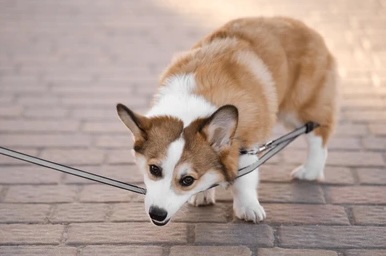
The ASPCA also suggests letting a light leash drag (only while you’re supervising). That way you can calmly lead a nippy puppy to a quiet spot without grabbing at it. If you haven’t built a crate routine yet, start with 4 reasons to crate train your dog.
4. Redirect to a toy and choose better games
- Offer a toy before your puppy goes for your hands. The ASPCA recommends noncontact games like fetch and keeping a toy in your pocket.
- For ankle biters: freeze, pull out a tug toy, and only start walking again once your pup is busy with the toy.
- Skip hand wrestling and waving fingers in your puppy’s face. Both teach that hands are toys.
Where the experts disagree: tug-of-war. The ASPCA suggests tug as a good outlet once your puppy can play it safely. The AVMA advises avoiding highly excitable games like wrestling or tug-of-war because they can raise the risk of a nip. Our take: if you play tug, play it with rules. Your puppy lets go on cue, and the game ends the moment teeth touch skin. With young kids in the house, skip it for now.
5. Teach an “instead” behavior
A puppy can’t sit and bite your sleeve at the same time. Teach a few simple cues:
- Sit before petting, before the door opens, before the leash goes on
- Look at me to break the excitement (here’s our “look at me” game)
- Place or a crate break when the household gets busy
The AVMA lists basic commands like “sit,” “stay,” “no” and “come” as part of preventing bites. Puppies need to learn both halves of the deal: what earns good things, and what makes the fun stop.
6. Use a taste deterrent if you need to
The ASPCA and AKC both mention bitter sprays as a backup. Some puppies actually like the taste, so treat sprays as a helper, not the whole plan.
7. Be consistent across the whole family
One person who lets the puppy chew on their hands can undo everyone else’s work. See why the entire family should take part in dog training.
What should you avoid when your puppy bites?
- Hitting, nose taps, scruff shaking or “alpha rolls.” The ASPCA warns that slapping or hitting a puppy for playful mouthing can make it bite harder or become fearful. Fair, consistent consequences are part of training. Rough handling isn’t.
- Jerking your hands away. It turns your hand into prey. Go limp or still instead.
- Shutting down all play. The ASPCA notes play builds the bond. You want gentle play, not no play.
How do you keep kids safe around a mouthy puppy?
The AVMA reports that about half of dog bite victims are children. It also notes dogs may nip and bite during play, which can be dangerous for people if it isn’t managed. The AVMA’s advice:
- Always supervise young children around dogs, no matter how well-behaved either one is.
- Never leave a baby or small child alone with a dog.
- Teach kids to be careful and respectful around pets.
At home, kids shouldn’t run from a nippy puppy (that starts a chase). They stand still, and an adult handles the time-out. Read more in kids and dogs: building safe and loving relationships. The AVMA also notes dogs in pain are more likely to bite, so if biting suddenly changes, check with your vet.
When should you call a professional dog trainer?
Call a trainer if:
- Biting is getting worse, not better, after a couple of weeks of consistent work
- You see stiff bodies, growling or bites during handling
- Your puppy draws blood or bites children or guests
- Your family is starting to feel afraid of the puppy
Training early pays off. In a Japanese study of 142 dogs, Kutsumi and colleagues found dogs that attended a 6-week puppy class responded better to commands and to strangers than untrained dogs. Dogs in an adult class also did better on commands, so it’s never too late. See what age should I start training my puppy? for more on timing.
How does Off Leash K9 Training, Georgia help with puppy biting?
We’re veteran-owned and train with military and law-enforcement methods. We’re primarily e-collar trainers, with force-free options too, and we match the method to the dog. For puppies:
- Puppy Training Consultation. For pups under 5 months, covering house training, mouthing and jumping.
- 1-Week “Puppy” Board & Train. A jumpstart on crate routine, potty routine, intro commands with marker training, and bite inhibition. We also teach you how to curb puppy biting once your pup is home.
- Puppy Power Combo. The puppy board and train now, then our signature 2-week board and train when your pup is developmentally ready at around 5 months.
- 1-week and 2-week board and train programs. Real-world distraction training in stores, parks, trails and neighborhoods. Both include unlimited 1-hour private refresher lessons for the life of your dog. (The puppy board and train doesn’t include lifetime refreshers.)
Every program is on our packages page, with current pricing and financing through Affirm. Our first lesson comes with a money-back guarantee, and we train all ages, all breeds and all issues. See our training videos (we have over 5,000 before-and-after videos on YouTube), or visit our puppy training page and find your closest location.
Ready to put an end to the land shark phase? Call (770) 450-0988 (we’re available 9 AM to 6 PM Eastern, every day) or contact us for a free phone consultation. We’ll match you with a trainer at our Smyrna, Duluth, Peachtree City, Athens, Augusta, Macon or Columbus facility.
Puppy biting FAQ
At what age do puppies stop biting?
Teething is usually over by about 7 months, when the Merck Veterinary Manual says all adult teeth are in. Mouthing as a habit fades more slowly. Research shows it declines with age, but many dogs keep mouthing into adulthood without training.
Does yelping “ouch” stop puppy biting?
Sometimes. The ASPCA recommends a quick yelp and a limp hand to teach a softer mouth. If yelping has no effect, the ASPCA says to switch to brief time-outs.
Should I use a crate time-out for puppy biting?
Yes, if it’s calm and short. AKC recommends putting a puppy that keeps nipping in its crate with something to chew, as a time-out rather than a punishment.
Why does my puppy bite more at night?
Overtiredness is a big reason. AKC notes biting often increases when puppies get tired. A scheduled crate nap with a chew toy before the “witching hour” helps many pups.
Can a board and train help with puppy biting?
Yes. Our 1-Week Puppy Board & Train works on bite inhibition and teaches you how to curb biting at home. Older pups can move into our 1- or 2-week programs.
Where can I get help with puppy biting in Georgia?
Off Leash K9 Training, Georgia has facilities in Smyrna, Duluth, Peachtree City, Athens, Augusta, Macon and Columbus. Call (770) 450-0988, 9 AM to 6 PM Eastern every day.
Sources
- ASPCA. Mouthing, Nipping and Biting in Puppies.
- American Kennel Club. How to Stop a Teething Puppy From Biting You (2021).
- American Kennel Club GoodDog! Helpline. 8 Common Training Questions (e-book, PDF).
- American Veterinary Medical Association (AVMA). Dog Bite Prevention.
- Merck Veterinary Manual. Dental Development of Dogs.
- Waite, M. R., & Kodak, T. (2021). Owner-implemented functional analyses and reinforcement-based treatments for mouthing in dogs. Behavior Analysis in Practice. doi:10.1007/s40617-021-00554-y (free full text).
- Waite, M. R., Harman, M. J., & Kodak, T. (2021). Frequency and animal demographics of mouthing behavior in companion dogs in the United States. Learning and Motivation. doi:10.1016/j.lmot.2021.101726.
- Kinsman, R. H., et al. (2025). Owner-perceived undesirable behaviours in young dogs and changes with age. Animals, 15(8), 1163. Full text (PMC).
- Kutsumi, A., Nagasawa, M., Ohta, M., & Ohtani, N. (2013). Importance of puppy training for future behavior of the dog. Journal of Veterinary Medical Science, 75(2), 141-149. doi:10.1292/jvms.12-0008.